How Deep Should a Raised Garden Bed Be? Choose the Usable Root Zone
Compare raised-bed depth on soil or paving, source-specific crop ranges, container volume and a measured planter example before choosing a frame or ordering fill.
Start with the product that matches your constraint.
Use this compact matrix before reading the full guide. It keeps the choice grounded in fit, tradeoff, setup risk, and a current offer path without showing stale Amazon prices or ratings.
Start hereVego Garden
17" Tall 9-in-1 Modular Metal Raised Garden Bed Kit
Choose if
Compare the named 17-inch 9-in-1 kit configurations with your site.
Skip if
Shoppers who have not measured their space, fill volume, and walking clearance.
Check first
Check the selected layout, included hardware and accessory mounting requirements.
Best for: Gardeners comparing a bagged raised-bed mix for measured fill volume or top-offs, after checking the product instructions and crop rooting space
Key tradeoff: Bagged soil can be expensive for large beds
Raised garden bed depth is not a single number that works for every crop and every site. Start with the usable growing space, then ask whether roots can continue into suitable soil below. A low open-bottom frame on garden ground and a planter of the same height on concrete have different boundaries. The outside wall height alone does not describe either root zone accurately.
This guide helps you choose depth before buying a frame or ordering fill. It separates plant needs, working height, and soil volume so you can compare them without assuming taller is always better. For specific bed recommendations, use our vegetable raised bed guide; for mixing and placing the growing medium, continue to how to fill a raised garden bed.
Measure Three Different Things
First measure the outside wall height. This tells you about the physical frame, but it may include space that will not contain soil. Second measure the intended filled depth, allowing for the gap below the rim and any internal floor or reservoir. Third consider the effective rooting space: the filled layer plus any suitable, accessible soil beneath an open bottom.
University of Maryland Extension's raised bed guidance explains that roots in beds placed on the ground can grow into underlying soil. That distinction is why a modest wall can be useful on one site while a similar container on a hard surface needs a different plan. An open bottom is not proof that the ground underneath is suitable, however.
Record those three measurements separately when comparing products. A thirty-inch-tall elevated planter might contain a much shallower soil tray. A twelve-inch frame may be filled below its top edge. A raised bed with a water reservoir dedicates some internal space to water storage. None of these designs is automatically wrong; the problem is comparing them using only the largest advertised dimension.
Start With What Is Underneath
Base condition
How to think about depth
What to resolve first
Suitable garden soil under an open frame
Added soil is part of a larger rooting area
Underlying soil condition and crop requirements
Hard paving or concrete
Plan as a contained root zone
Drainage, sufficient medium, and surface suitability
Elevated planter floor
Only the supported soil chamber counts
Usable depth and the planter's load limits
Reservoir planter
Separate soil and water compartments
Soil chamber dimensions and system instructions
Compacted, obstructed, or uncertain ground
Do not assume roots can continue freely
Assess the site before selecting a depth
Walk the site before choosing the frame. Look for buried obstructions, dense surface conditions, drainage problems, and evidence of previous uses. Where soil quality is uncertain, use appropriate local testing and advice rather than assuming that adding a shallow clean layer resolves every concern. Keep contamination questions separate from ordinary fertility questions.
On hard surfaces, also plan where water will leave the bed. Depth does not solve a blocked outlet. A very deep container with poor drainage can still create unsuitable conditions, while a carefully designed container must balance water, air, and usable root volume. Follow the container's instructions and the requirements of the growing site.
Use Crop Guidance, Not a Universal Depth Chart
Begin with the vegetables you want to grow and consult guidance for those crops and varieties. Distinguish recommendations for open ground from recommendations for containers. A container recommendation may specify volume as well as depth because a narrow deep column and a broad shallow tray do not provide the same space or maintenance conditions.
For roots harvested below ground, consider the dimensions of the crop you are trying to produce and the condition of the soil within that space. For larger fruiting crops, consider total usable volume and the watering routine as well as depth. For short-season leafy crops, avoid assuming that every spare shallow tray is automatically adequate simply because the harvested portion is above the soil.
If you are still choosing crops, work backward from a manageable container or bed configuration. It may be easier to select varieties suited to a known growing space than to buy a small planter and force a large crop into it later. The container growing guidance from Maryland Extension is a useful starting point for that separate container-planning decision.
Read the Conditions Beside a Published Depth
For a bed on paving, Maryland Extension's raised-bed guidance gives the following starting points. These are its hard-surface recommendations, not universal wall heights or a promise of yield.
Hard-surface bed crop group in that source
Growing depth stated by Maryland
Leafy greens, beans and cucumbers
At least 8 inches
Peppers, tomatoes and squash
12–24 inches
The same source warns that these beds depend on the water held inside them and can experience heat from surrounding paving. Its advice for improving poor or compacted ground is a different situation; do not turn its added-soil layer into a container specification.
For a separate container decision, Maryland's container-size guide pairs depth with volume. Its large-vegetable category, including tomatoes, calls for one plant per container, at least 8–10 gallons of medium and 12–16 inches of depth. Its medium and small categories have other ranges. Do not combine the smallest number from one category with the crop list from another.
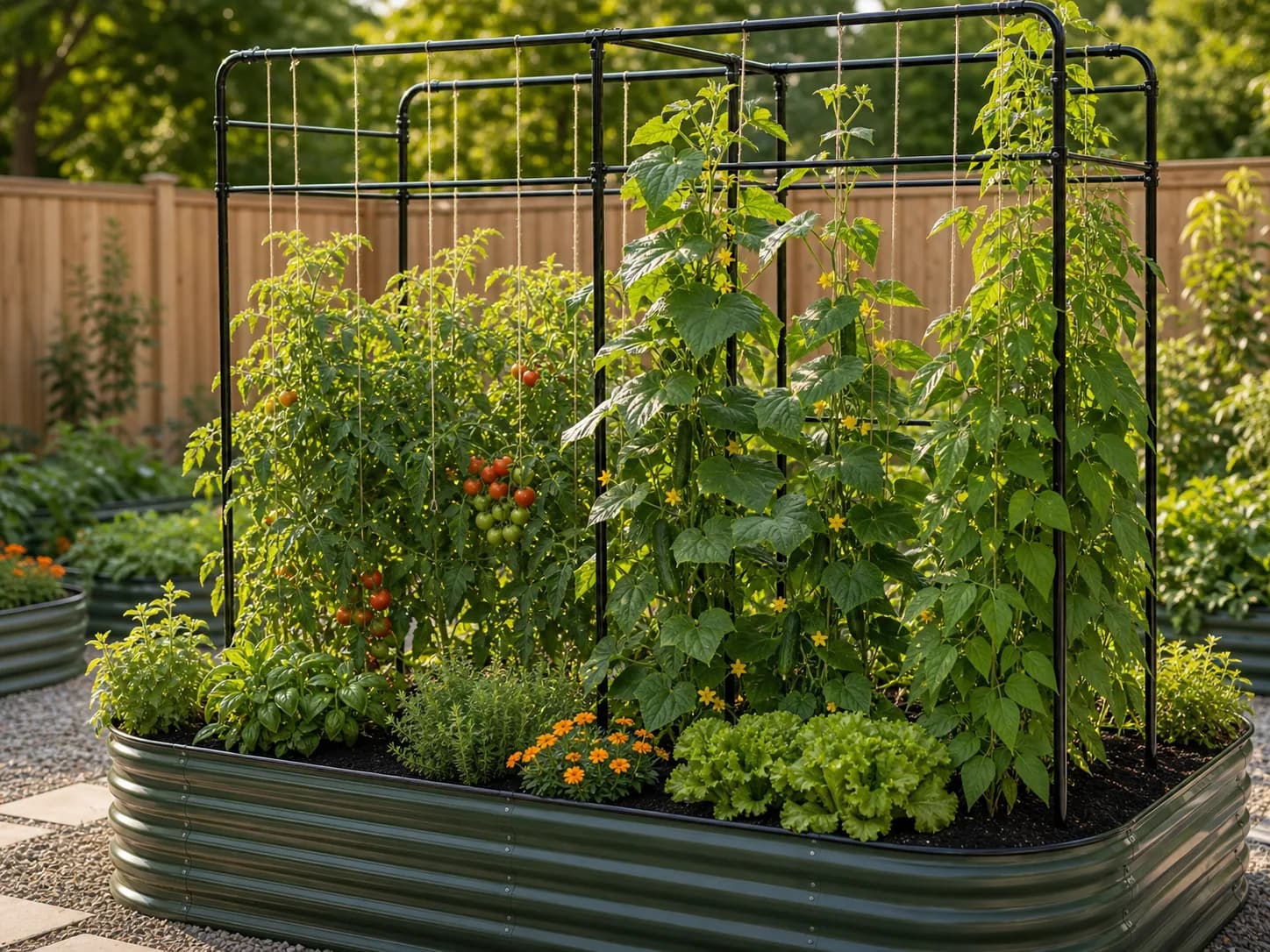
These recommendations address different growing systems. A cucumber appearing in both lists does not make an eight-inch-deep narrow pot equivalent to a wider bed on paving. Record the source, crop or variety, growing system, depth and volume together. Check planting spacing and mature support needs separately with the tomato support guide.
Check a Planter Drawing Before You Buy
Use a dimension drawing or your own measurements to complete this short record. If the seller supplies only overall height, ask for the missing soil-chamber dimensions before ordering.
Record the exact model and selected configuration, then the inside length and width at the soil chamber. Note tapering sides, rounded corners and braces.
Measure from the soil-supporting floor to the rim. For a reservoir design, identify the boundary of the growing chamber in its instructions rather than counting water-storage space as soil.
Mark the intended soil line below the rim. Subtract the unfilled gap to find the planned growing depth; leave any designed air space or overflow arrangement intact.
Calculate that chamber's volume, then compare both depth and volume with the crop guidance. Check the manufacturer's filled-load, drainage and assembly instructions separately.
For a hypothetical straight-sided planter, suppose the rim is 30 inches above the ground, the supporting floor is 16 inches above the ground, and the intended soil line is one inch below the rim. The usable growing depth is 30 − 16 − 1 = 13 inches, not 30. If the inside opening is 24 by 18 inches, its geometric medium volume is 24 × 18 × 13 ÷ 1,728 = 3.25 cubic feet. This is an arithmetic example, not a product specification, load rating or crop-fit certification.
Changing a shelf position or removing a reservoir to gain depth changes the design; this calculation is not permission to do either. For the growing medium, follow the soil selection guide. For ground-level frames with proposed liners or bulky lower fill, use the bottom-material guide before counting the whole wall as rootable soil.
Calculate How Depth Changes Fill Volume
For a rectangle, multiply inside length by inside width by intended fill depth, with all measurements in the same units. If length and width are in feet but depth is in inches, divide depth by twelve first. The result is cubic feet. Divide cubic feet by twenty-seven to express the same volume in cubic yards.
Inside footprint
Intended fill depth
Geometric volume
Cubic yards
4 by 8 feet
6 inches
16 cubic feet
About 0.59
4 by 8 feet
12 inches
32 cubic feet
About 1.19
4 by 8 feet
18 inches
48 cubic feet
About 1.78
4 by 8 feet
24 inches
64 cubic feet
About 2.37
These figures compare hypothetical inside openings, not the specifications of a particular product. Rounded corners, internal braces, reservoirs, and sloping sides change the actual volume. A frame sold as four by eight may use outside dimensions, so measure the soil opening before ordering. Use the raised bed soil calculator for your own dimensions.
Each extra six inches in this example adds sixteen cubic feet. If bags contain two cubic feet each, that increment corresponds to eight bags before any adjustment for settlement or measurement differences. This illustrates why choosing height first and calculating fill later can change the project unexpectedly. It also helps compare one deeper bed with several lower beds without relying on live product prices.
Keep Working Height Separate From Rooting Depth
If you want less bending, test the proposed rim and planting-surface heights from your actual working position. Use a stable temporary reference rather than guessing from a photograph. Check reach to the center, not only comfort at the nearest edge. A tall bed that is too wide may replace bending with stretching.
For seated gardening, approach space, knee clearance, and turning room may be as important as the height of the growing surface. A raised frame filled to the ground and a planter with space underneath offer different access. Compare beds for seniors and elevated beds according to the user's needs rather than treating either category as universally accessible.
If a purpose-designed planter raises a soil tray on legs, count the tray's actual soil depth for crop planning. Do not fill a shelf or void that was not designed to hold medium. Likewise, do not add an improvised false bottom to a tall bed without checking the required support and drainage. Working height is a design feature, not permission to alter structural components.
Deep Beds Need a Whole Filling Plan
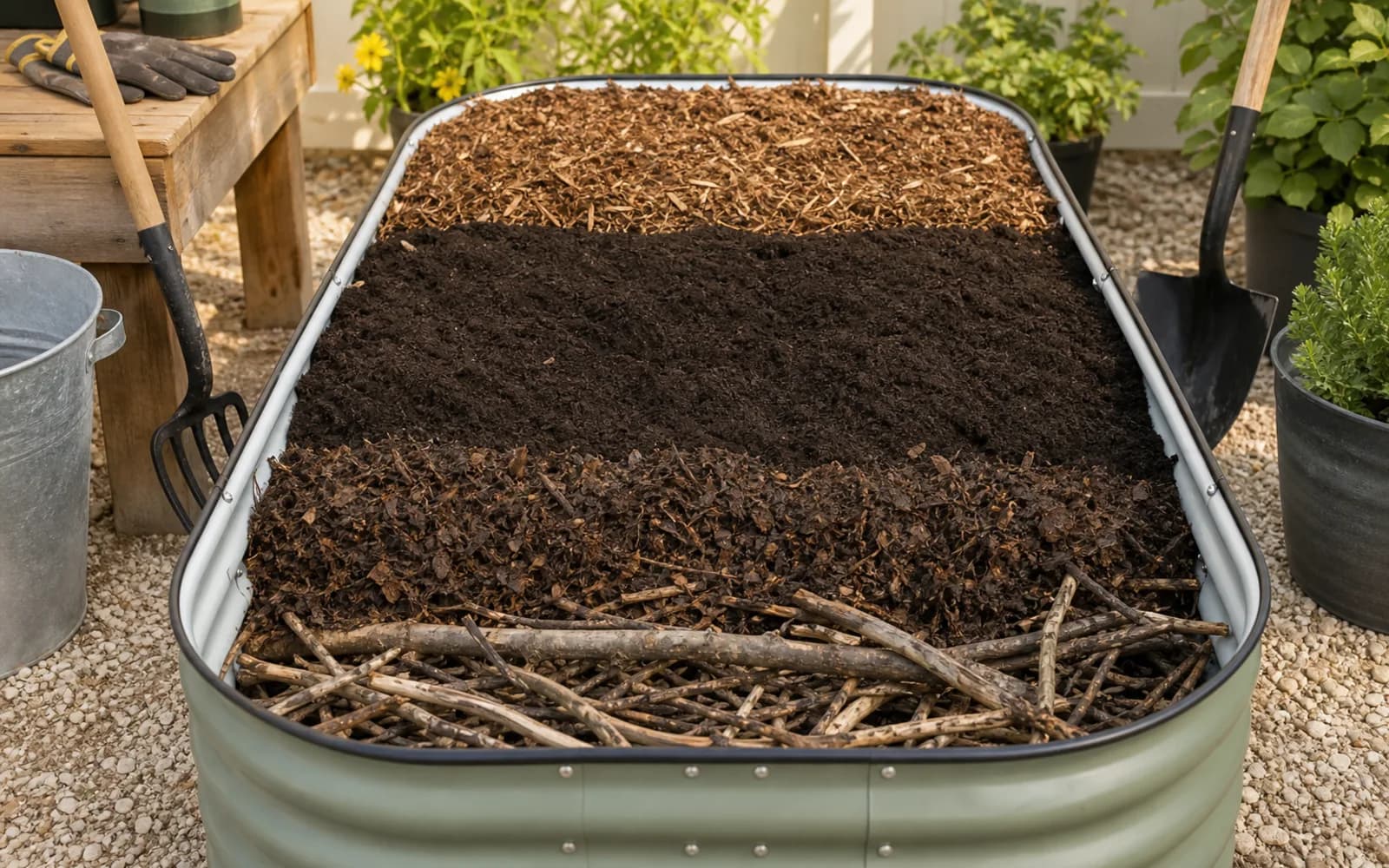
A deep frame can require a substantial quantity of growing medium. Before looking for cheaper lower-fill materials, decide how much continuous suitable rooting space the intended crops need. Large pieces of wood or other bulky material do not count as an equivalent depth of usable soil. They also change the way the filled bed behaves over time.
This is where the depth decision hands over to the filling guide. Compare available materials, delivery access, settling, and the condition of the soil underneath. Do not compress everything aggressively just to fit the expected volume inside the frame. Inspect the walls and connections as you fill, especially with tall structures.
Record the soil surface level after the initial settling period and again before a later planting. That gives you an actual measurement for future top-ups. It is more useful than repeatedly ordering from the original advertised bed volume, which may include a gap below the rim or space occupied by materials that are not growing medium.
Three Scenarios for Making the Decision
For a first vegetable garden on suitable ground, begin with the crop plan and the existing soil assessment. A modest open-bottom frame may provide the defined growing area you want without the fill requirement of a much taller bed. Confirm reach and paths first. Choose a deeper structure only when its purpose is clear, such as additional suitable growing space or a specific access goal.
For a patio garden, treat the planter as a contained system. Check usable soil volume, crop suitability, drainage, support attachments, and the capacity of the surface underneath. Do not transfer a depth recommendation from a garden bed with open ground below and assume it applies unchanged. The self-watering planter guide explains another common internal-space distinction.
For a garden designed around easier maintenance, start with the person doing the work. Test the working surface, the reach distance, and the route around the bed. Then choose a structural design and crop plan that fit those dimensions. Sometimes a narrower bed is the useful change; sometimes an elevated planter is more suitable. Simply adding wall height can increase fill handling without improving access.
Questions to Answer Before Buying Soil
Write down the actual inside opening and the location of any floor, reservoir, or obstruction. Mark the intended soil line. Identify the crop guidance you are using and whether it refers to container or in-ground growing. Finally, note how you will water, where excess water goes, and what support the mature crop needs.
Calculate at least two feasible depths if the design allows it. Compare the difference in volume, handling, and working height. Check whether that difference delivers a benefit you actually need. This is a practical budget exercise even without entering prices: a larger volume must be transported, moved, contained, and maintained regardless of where the material is purchased.
If the answers depend on uncertain ground conditions or unspecified planter dimensions, resolve those uncertainties first. It is easier to ask for a dimension drawing or assess the soil before delivery than to remove a completed planting because the available root chamber was misunderstood.
Compare Two Wall Heights Before Ordering Fill
Amazon paid links: we may earn a commission from qualifying purchases through the links below.
The lower frame is worth considering when your crop and site plan does not call for a taller wall. Consider the taller version only when the added height serves your access or growing-space needs and you have allowed for the additional fill and assembly. Vego's 26-inch model documentation provides a starting point for checking the model; confirm the selected Amazon variant before purchase. Neither exterior height is a promise of the final filled depth.
Frequently Asked Questions
Is a twelve-inch raised bed always deep enough?
No single wall height suits every crop and site. Check the actual filled depth, usable volume, crop requirements, and whether roots can access suitable soil beneath the bed.
Does the height of an elevated planter equal its soil depth?
No. Legs, shelves, reservoirs, and the gap below the rim can reduce usable growing depth. Measure the soil chamber rather than relying on overall height.
How much soil does an extra six inches require?
For a rectangular four-by-eight-foot inside opening, an extra six inches adds sixteen cubic feet. Use your own inside dimensions because product labels may describe the outside footprint.
Will making a bed deeper fix drainage problems?
Not by itself. Assess the base, growing medium, and drainage route. A blocked outlet or unsuitable underlying conditions need their own solution.